
Do your daily decisions, behaviors, and priorities consistently align with your organization’s strategic goals—or are you unintentionally sending mixed signals to your team?
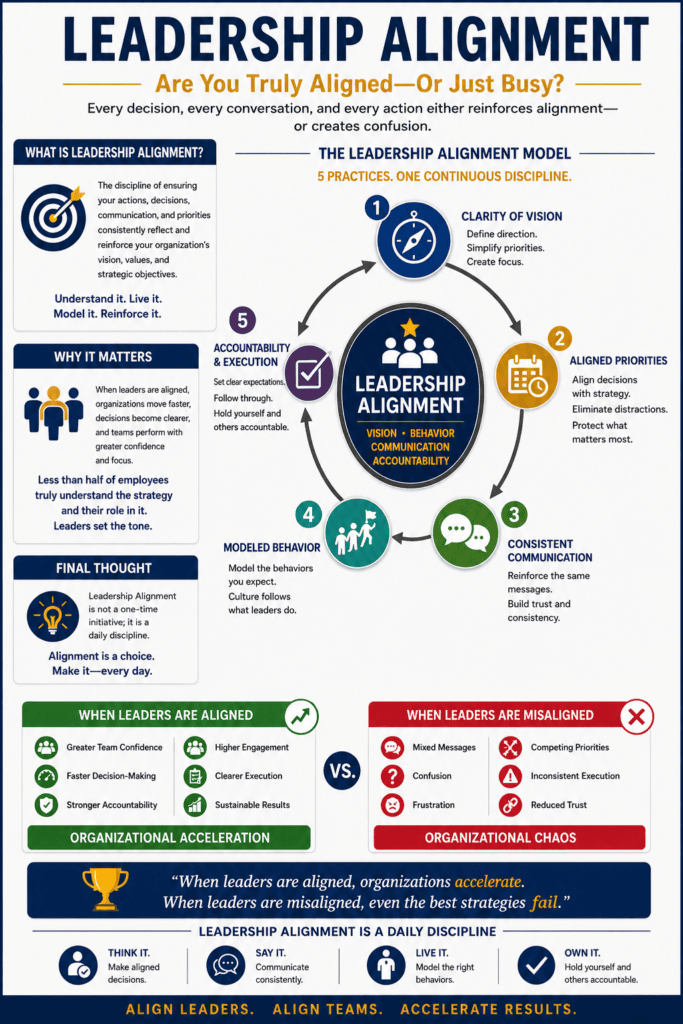
What Is Leadership Alignment? Leadership Alignment is the discipline of ensuring that your actions, decisions, communication, and priorities consistently reflect and reinforce your organization’s vision, values, and strategic objectives. It goes beyond simply understanding the strategy—it requires leaders to live it, model it, and reinforce it in everything they do. When alignment is strong, leaders create clarity and direction. When alignment is weak, leaders create confusion—often without realizing it.
Why Leadership Alignment Matters – Our research indicates that less than half of employees surveyed “truly” understand their organization’s strategy and how their role contributes to it. This gap typically exists because the strategy itself is unclear, confusing, and complicated. And often, the gap exists because their leaders are also unclear and misaligned in how they communicate, prioritize, and execute on the strategy. However, we know that when leaders are aligned, organizations move faster, decisions become clearer, and teams perform with greater confidence and focus.
A Real Leadership Moment – In my Executive Coaching practice, I recently worked with a senior leader who was incredibly sharp, highly respected, and deeply committed to her organization’s success. She told me, “Theo, I don’t understand why my team isn’t executing with urgency. We’ve talked about our priorities multiple times.” So I asked her a simple question: “When was the last time you sat down with each of your direct reports and asked them to walk you through their top priorities—and how they connect to your strategic goals?”
She paused, then said, “I haven’t done that… not directly.” So we made a small shift. She began using her 1-on-1 meetings differently. Instead of just reviewing updates or solving problems, she started asking questions like: “What are your top 3 priorities right now?” “How do those priorities align with our strategic goals?” And “Where do you need more clarity from me?”
What happened next was powerful. She quickly realized that while her team heard the strategy, they were interpreting it differently. Some were focused on the right things… others were not. But here’s the key: Once she created space for those conversations, alignment improved almost immediately. Not because the strategy changed… But because the clarity and reinforcement did.
The Impact of Leadership Alignment – When Leadership Alignment is strong, organizations experience clarity at every level. Teams understand what matters most and can move forward with confidence. Decision-making becomes faster and more consistent because leaders are operating from the same framework. Trust and credibility increase because leaders are seen as consistent and reliable, and execution improves because everyone is moving in the same direction.
However, when Leadership Alignment is weak, the opposite occurs. Leaders may unintentionally send mixed messages—saying one thing but prioritizing another. This creates confusion throughout the organization, leaving teams uncertain about what truly matters. Accountability begins to erode because expectations are unclear, and results become inconsistent across departments. Over time, this misalignment can quietly undermine even the strongest strategies.
How to Strengthen Leadership Alignment – Strengthening Leadership Alignment begins with clarity. Leaders must define the few priorities that matter most and ensure those priorities are simple, visible, and consistently reinforced. Equally important is aligning behavior with those priorities. One of the most revealing exercises is to evaluate how time is spent—because a leader’s calendar often tells the real story of what is truly important.
Communication also plays a critical role. Leaders must consistently reinforce the same messages across meetings, conversations, and written communication. Repetition is not unnecessary—it is essential for building clarity and alignment. In addition, leaders must model the behaviors they expect from others. Teams pay far more attention to what leaders do than what they say.
Finally, alignment requires accountability. Clear expectations must be established, and leaders must follow through—both with themselves and their teams. Without accountability, alignment becomes nothing more than good intention without real impact.
Final Thought – Leadership Alignment is not a one-time initiative; it is a daily discipline. Every decision, every conversation, and every action either reinforces alignment or creates confusion. The difference between high-performing organizations and struggling ones often comes down to this single factor. “When leaders are aligned, organizations accelerate. When leaders are misaligned, even the best strategies fail.”
To learn more about our new CLARITY Leadership & Executive Coaching Programs, click here to schedule a complimentary executive briefing and/or a 30-minute coaching session, and discover how to position yourself or your emerging leaders for sustained success. Or email us at info@psbydesign.com.
Let’s build leaders who don’t just step in roles, but transform them!