
How a Lack of Clarity Creates Confusion, Complexity, and Chaos
Every leader influences the culture of their organization—for better or worse. While most leaders genuinely want to inspire, motivate, and achieve great results, many unintentionally create confusion, frustration, and disengagement because they lack one critical leadership quality: clarity.
Leadership dysfunction rarely begins with bad intentions. More often, it develops through daily habits that slowly erode trust, alignment, accountability, and execution. These behaviors become so common that organizations begin to accept them as “the way we’ve always done things.”
The good news is that dysfunctional leadership is not a personality trait. It’s a pattern of behaviors—and behaviors can change. Below are seven habits that often signal a leader is operating without clarity.
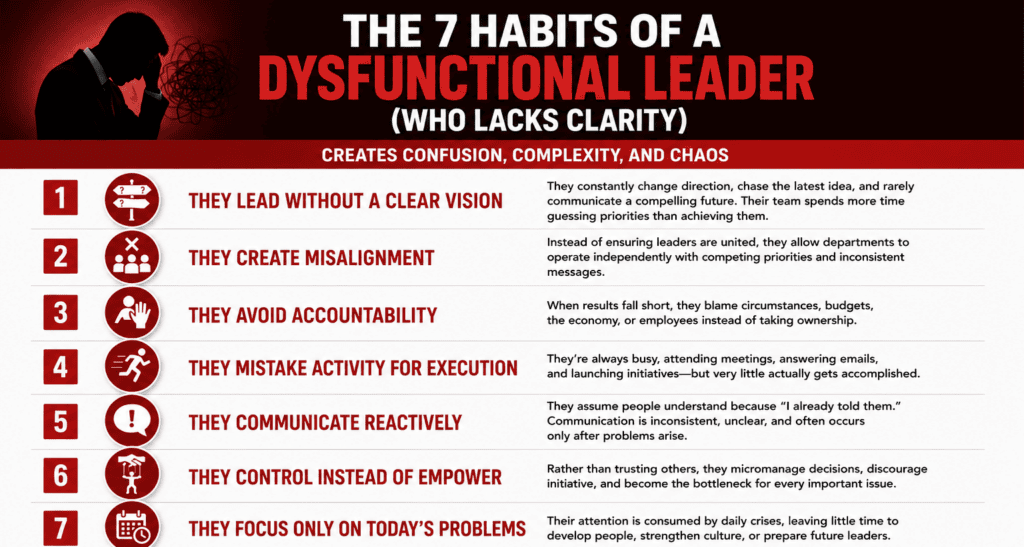
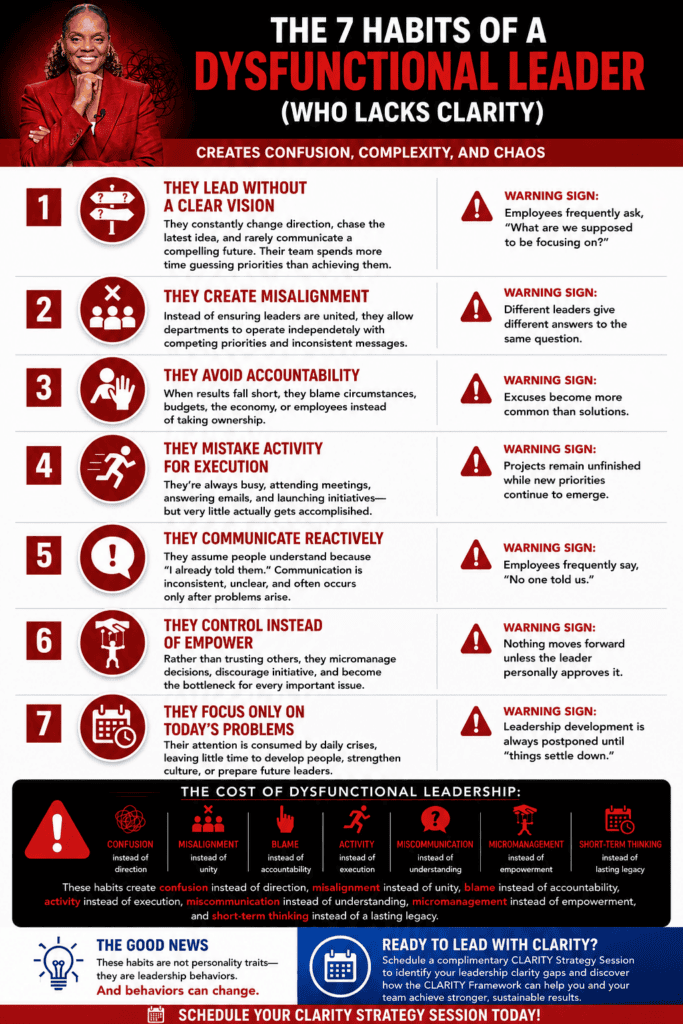
1. They Lead Without a Clear Vision – Teams cannot confidently move forward when leaders continually change direction or fail to communicate a compelling picture of the future. Employees spend more time guessing priorities than executing them. The result: Constant shifting priorities; Reduced confidence; Decision paralysis; and Frustrated employees. Ask yourself: If I asked everyone on my team our top three priorities, would they all give the same answer?
2. They Create Misalignment – When leaders fail to ensure alignment across departments, every team begins operating independently with competing priorities. Meetings become debates instead of planning sessions, and collaboration is replaced by silos. Misalignment creates duplicated work, inconsistent customer experiences, and internal conflict. Healthy leaders create unity. Dysfunctional leaders unintentionally create competing agendas.
3. They Avoid Accountability – When results fall short, dysfunctional leaders often point to budgets, staffing shortages, market conditions, or employee performance before examining their own leadership. Great leaders ask: “What could I have done differently?” Ownership builds credibility. Excuses destroy it. When leaders model accountability, teams begin doing the same.
4. They Mistake Activity for Execution – Busy doesn’t always mean productive. Many organizations celebrate full calendars, endless meetings, overflowing email inboxes, and constant urgency while measurable results remain stagnant. Activity without execution creates the illusion of progress. The most effective leaders focus less on being busy and more on producing meaningful outcomes.
5. They Communicate Reactively – One of the most common phrases heard inside dysfunctional organizations is: “I thought everyone already knew.” Unfortunately, assumptions are one of leadership’s greatest enemies. Reactive communication means information is shared only after problems arise. Expectations remain unclear, updates are inconsistent, and employees are left filling in the gaps themselves. Clear leaders communicate early, often, and consistently.
6. They Control Instead of Empower – Micromanagement is usually not a trust problem—it is often a clarity problem. When leaders fail to clearly define expectations, decision-making authority, and desired outcomes, they compensate by controlling every decision themselves. Eventually, they become the bottleneck. Empowered employees make faster decisions, develop confidence, and take greater ownership because they understand both the destination and the boundaries.
7. They Focus Only on Today’s Problems – Many leaders spend every day putting out fires. While crisis management is sometimes necessary, organizations cannot thrive when every day is consumed by today’s emergencies. Dysfunctional leaders rarely invest time developing future leaders, strengthening culture, or improving systems because they remain trapped in constant reaction mode. Exceptional leaders balance today’s responsibilities while preparing for tomorrow’s opportunities.
The Hidden Cost of Dysfunctional Leadership – These seven habits create consequences that extend far beyond missed deadlines. They produce: Confusion instead of direction; Misalignment instead of unity; Blame instead of accountability; Activity instead of execution; Miscommunication instead of understanding; Micromanagement instead of empowerment; and Short-term thinking instead of lasting leadership. Over time, employee engagement declines, trust erodes, turnover increases, innovation slows, and organizational performance suffers. The greatest cost is often invisible—the untapped potential of talented people who could achieve extraordinary results if they were led with greater clarity.
The Good News – The encouraging reality is that these habits are learned—not permanent. Leaders who intentionally develop greater clarity create organizations where people understand the vision, know what’s expected, communicate effectively, take ownership, collaborate with confidence, and consistently deliver better results. Leadership transformation doesn’t begin with working harder. It begins with leading more clearly.
Final Reflection – Take a moment to honestly evaluate your own leadership. Are your priorities consistently understood? Are your teams aligned around common goals? Do you model accountability? Are you measuring execution instead of activity? Do people clearly understand your expectations? Are you empowering others or controlling every decision? And, are you preparing your organization for the future?
The answers to these questions may reveal the single greatest opportunity to strengthen your leadership. Because organizations rarely rise above the clarity of their leaders. When leaders gain clarity, teams gain confidence. When teams gain confidence, organizations gain momentum. And when momentum is sustained, exceptional results become possible.
Ready to Lead with CLARITY? If you’d like to identify leadership gaps before they become organizational problems, consider participating in a CLARITY Strategy Session or Leading with CLARITY Workshop. Together, we’ll assess your organization’s current leadership habits, uncover opportunities for improvement, and develop practical strategies that create greater alignment, accountability, communication, and execution. Remember: Clarity isn’t just another leadership skill—it is the foundation upon which every other leadership competency is built.
Theo Gilbert-Jamison | Email: info@psbydesign.com