
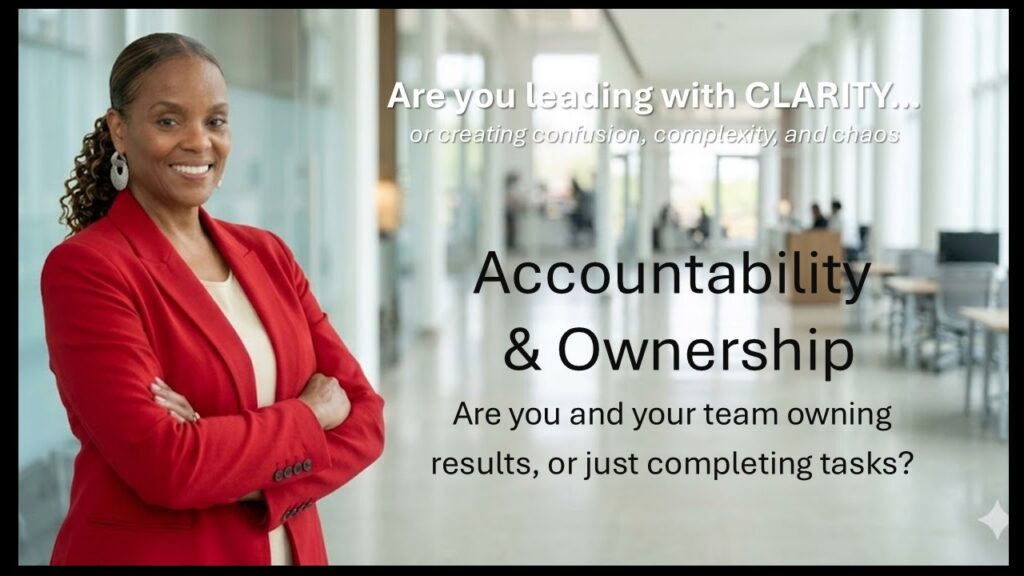
In many organizations, employees work hard, attend meetings, answer emails, and complete assignments. Yet despite all this activity, leaders are often left wondering: Why aren’t we achieving the results we expected?
The answer may lie in the difference between completing tasks and owning results.
Completing a task means doing what was assigned. Owning a result means accepting responsibility for the outcome the task was intended to produce. This distinction is at the heart of A—Accountability & Ownership, one of the Seven Pillars of Exceptional Leadership within the CLARITY Leadership Framework.
Activity Is Not the Same as Achievement
A team can be extremely busy without being genuinely productive. Employees may complete reports, make calls, attend training, or participate in meetings. But if those activities do not produce the intended outcomes, can the work truly be considered successful?
Consider the difference between an employee saying, “I sent the email,” and saying, “I confirmed that everyone received the message, understood the expectations, and knew what action to take.”
The first statement focuses on completing a task. The second focuses on achieving a result.
Tasks matter, but tasks are only the means. Results are the destination. When leaders fail to make this distinction clear, employees may believe their responsibility ends when the task is completed—even if the desired outcome has not been achieved.
Accountability Begins with CLARITY
Accountability is difficult to establish when expectations are vague. Before leaders can hold employees accountable, they must clearly explain the expected outcome, why it matters, who owns it, what success looks like, when it must be achieved, and how progress will be measured.
If employees leave a conversation knowing what to do but not understanding what they are expected to accomplish, the leader has communicated a task rather than a result.
For example, “Please follow up with the customer” leaves several questions unanswered. Why is the employee contacting the customer? What problem must be resolved? When should the follow-up occur? What would represent a successful outcome?
A clearer expectation would be: “Please contact the customer by 3:00 p.m., understand the concern, resolve the issue within your authority, and confirm that the customer is satisfied.”
The second expectation creates greater accountability because it defines completion in terms of the desired result.
What Ownership Looks Like
Ownership is more than accepting blame when something goes wrong. It is a mindset demonstrated before, during, and after the work.
Employees who demonstrate ownership seek clarity, understand the purpose behind their responsibilities, anticipate barriers, and communicate concerns early. They monitor progress, request support when necessary, and remain engaged until the intended result is achieved.
Ownership sounds like: “Here is what I committed to accomplish. Here is our progress. Here is the challenge we encountered. Here is what I am doing to address it, and here is when you can expect the final result.”
Unexpected obstacles, shifting priorities, and external factors will always exist. Ownership does not mean controlling every circumstance. It means taking responsibility for responding to those circumstances rather than using them as excuses for inaction.
Leaders Create Accountability
Leaders cannot simply demand accountability. They must create an environment that supports it.
That begins with modeling the behavior they expect from others. When leaders make excuses, avoid difficult conversations, or fail to follow through, employees notice. When leaders acknowledge mistakes, honor commitments, communicate openly, and focus on solutions, employees notice that too.
Every important priority should have a clearly identified owner. Collaboration may involve several people, but someone must be responsible for monitoring progress and ensuring the result is achieved. When everyone is generally responsible, no one may feel personally accountable.
Leaders should also schedule progress checkpoints before the deadline. Accountability should not begin after a commitment has already been missed. Regular follow-up allows leaders and employees to identify barriers, clarify expectations, and make adjustments before performance suffers.
Employees must also have the appropriate authority, resources, training, and support. Accountability without support can quickly become frustration. Leaders should remove unnecessary barriers while allowing employees to own the execution.
Address Missed Commitments
A culture of accountability requires leaders to address missed expectations promptly and respectfully. Repeatedly overlooking missed deadlines or incomplete work quietly lowers the team’s standards.
The purpose of an accountability conversation is not to embarrass or punish someone. It is to understand what happened, reinforce the expectation, agree on corrective action, and prevent the issue from continuing.
Leaders should also recognize employees who demonstrate ownership. When someone communicates proactively, solves a problem, accepts responsibility, or ensures that the desired result is achieved, acknowledge it. What leaders consistently recognize becomes part of the team’s culture.
The Leadership Challenge
Review your team’s most important priorities. Can every employee clearly explain the results they own? Does each major priority have an identified owner? Are success measures and deadlines clear? Do employees communicate obstacles before commitments are missed? Do leaders consistently follow up and model accountability?
If these questions are difficult to answer, your team may have an accountability gap.
Select one important priority and clarify the expected result, owner, deadline, success measures, potential barriers, and next progress-review date. This simple conversation can prevent misunderstandings and strengthen performance.
Busy teams complete tasks. Accountable teams achieve results. Exceptional leaders help their teams understand the difference.
Are you ready to strengthen accountability, increase ownership, and help your leaders move beyond activity to measurable results?
Contact me at info@psbydesign.com to schedule a Leading with CLARITY Workshop or CLARITY Strategy Session for your organization. Together, we will identify accountability gaps, clarify expectations, strengthen follow-through, and help your leaders and teams consistently own the results that matter most.
The question is not simply, “Was the work completed?” The real question is: “Did we achieve the result—and who owned it?”